Introduction
Emerging markets across South and Southeast Asia are entering a decisive phase in the global energy transition. Electricity demand is rising at some of the fastest rates in the world, grid systems are under mounting pressure, and governments are advancing ambitious decarbonisation strategies. Solar photovoltaic (PV) generation and battery energy storage systems (BESS) have achieved a level of commercial maturity and cost competitiveness that positions them as central components of future energy systems.
Recent geopolitical developments have further highlighted the vulnerability of global energy systems to fuel price volatility and supply disruption, particularly for import-dependent economies, reinforcing the urgency of diversifying towards more stable and resilient energy solutions.
As attractive replacements for traditional thermal generation, they are increasingly becoming an investment story about scale and system value – from large scale generation assets to remote mini-grids. They directly address the energy trilemma comprised of cost-effectiveness, security and sustainability, whilst delivering bankable and adequate returns for investors. Despite this, institutional capital is not flowing into these markets at the pace or scale required.
Capital is shifting to clean power
Global energy investment reached about USD 3.3 trillion in 2025, with approximately twice as much capital flowing into clean energy versus fossil fuels[1]. Solar PV is now the single largest class of investment according to the IEA[2], yet, emerging markets and developing economies still receive only one fifth of global clean energy investment, despite accounting for a much larger share of population and demand growth[3]. This highlights a structural under-allocation of capital relative to the fundamental drivers.
Cost-effectiveness
In the cost-effectiveness component of the energy trilemma, hybrid PV and BESS assets increasingly outperform thermal generation across Southeast Asia. The downward pricing trend continues to accelerate. In the Philippines the levelised cost of electricity (“LCOE”) for hybrid PV and BESS achieved USD 94/MWh compared to USD 99 /MWh from natural gas in 2025 representing 5% reduction. By 2030, this same reduction is projected to be 29%[4].
Recent developments in the Middle East have underscored the continued exposure of global energy markets to geopolitical disruption. Volatility in oil and gas supply has translated into price spikes, with the impact most acutely felt by energy-importing economies and end consumers. These dynamics have further accelerated the cost competitiveness of renewable energy, particularly solar PV and BESS, thus strengthening the economic case for their immediate and sustained deployment.
On larger island and mainland grid systems, the rapid fall in solar and BESS costs have made renewables a mainstream capacity option, with several ASEAN and South Asian power development plans now embedding large scale investments in hybrid PV and BESS solutions due to the cost-effectiveness driver. This can be seen operationally in India, which as of 31st October 2025 had successfully commissioned 129.9GW[5] of solar, and had issued tenders for 66GWh[6] of BESS, both standalone and hybridised.
Security
Energy security has become a fundamental driver of investment decisions, with governments prioritising a domestic, diversified supply over exposure to imported fuels and volatile global markets[7]. In emerging markets this increasingly means hybridising variable renewables, such as solar with BESS to provide reliable, dispatchable generation that can reduce the requirement for expensive, carbon intensive gas or liquid fuels[8].
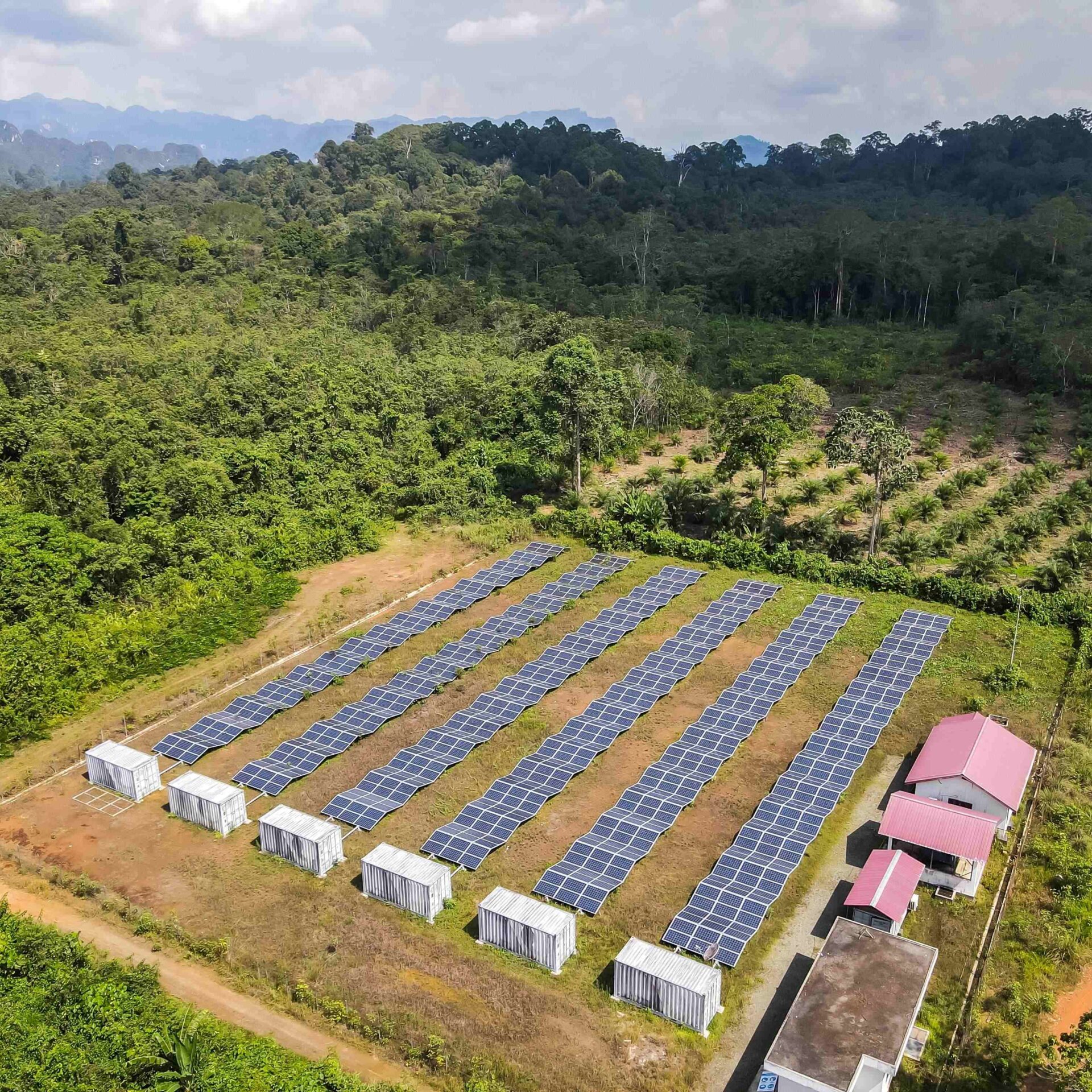
For small and medium-size islands, hybrid solar and BESS mini-grids reduce dependence on vulnerable fuel supply chains and provide black-start and islanding capabilities, thus materially improving resilience. On larger grids, utility-scale batteries and hybrid renewable plants are procured specifically for ancillary services such as frequency response and peak shifting. This has opened new bankable and long-term revenue streams beyond market-driven energy arbitrage opportunities.
Sustainability
Sustainability, the third element of the energy trilemma, is addressed through the replacement of traditional carbon-intensive fuels with RE generation. This substantially reduces greenhouse gas emissions, local air pollutants and aligns assets with tightening climate and ESG frameworks as part of the UN’s Sustainable Development Goals and individual government policy. Many emerging markets have adopted ambitious renewable and net-zero targets, with Southeast Asia’s transition scenarios pointing to substantial growth in solar, wind and storage as key levers to meet demand while decarbonising[9].
Multilateral initiatives and blended finance platforms are increasingly focused on derisking private investment in these markets, using guarantees and concessional capital to bring in commercial investors at scale. For investors, this combination of policy clarity, impact alignment and risk‑sharing mechanisms strengthens the risk–return profile of both greenfield and brownfield renewable assets.
Addressing risk: RE assets are bankable and investable
Globally, solar and BESS assets have demonstrated enduring bankability and investability from technical, economic, and operational perspectives. Real-world assets have operated reliably for over a decade in emerging markets. Field studies of hybrid systems in off‑grid islands in the Philippines maintain stable voltage and frequency within grid-code tolerances and report materially improved reliability and reduced outage durations compared with diesel‑only systems[10]. These mature, field-tested technical, economic and operational fundamentals underpin robust investment decisions, assuring investors of predictable cash flows independent of further innovation cycles.
The mismatch between required and deployed capital
Investors and developers often chase narrow technology themes such as “pure solar” or “stand‑alone BESS” within mandated pre-determined geographies, overlooking the underlying energy fundamentals that drive long‑term returns. Recent regional outlooks show that electricity demand across ASEAN is projected to grow strongly, with an average annual growth of ~7.3% to 2030 in some scenarios, underpinned by rapid urbanisation and industrialisation. The IEA supports this, projecting demand will double by 2050 under the current trajectory[11].
The mismatch remains and in order to achieve cost effective, secure and net zero pathways ASEAN requires a 3-5x increase in renewable capacity by 2035[12].
The reason for this mismatch lies in fragmentation. A large share of emerging market opportunities sit in sub 50MW projects. These are too small typically for institutional mandates that seek USD 100M+ tickets and clear secondary market liquidity combined with a wariness of unfamiliar hybrid offtake structures. Furthermore, external blockers such as inconsistent grid codes, permitting timeframes of 12–18 months and FX volatility of up to 10–15% in markets like Indonesia increase perceived execution risk and raise return thresholds, even where the underlying project economics are robust.
A core issue is the absence of standardised investment models that translate technically sound renewable projects into “institution‑ready” assets. This would involve standardised criteria of offtake agreement frameworks, minimum debt service coverage ratios (DSCR), technology standards and ESG safeguards which would allow investors to assess and approve projects in a more timely manner. This may be comparable to the project finance market utilised by conventional independent power producers.
In reference to the energy trilemma, the challenge is not only with the initial asset ticket size but the visibility of a scalable pipeline. If developers can demonstrate a credible trajectory from a cluster of smaller projects to a replicated portfolio that systematically lowers costs, improves security of supply and decarbonises local grids, the trilemma is progressively resolved at portfolio rather than single‑project level, making size less of a constraint over time.
Catalytic capital has a critical role in bridging this gap, with early‑stage and impact‑oriented investors providing seed capital and first‑loss tranches that validate business models, and establish performance benchmarks that can be followed by institutional investors. By combining standardised criteria, a visible scaling pathway and strategically deployed catalytic capital fragmented, yet fundamentally attractive, distributed renewable energy opportunities can be transformed into bankable, repeatable, and ultimately institutional‑grade investments.
From an investor’s perspective, there is a clear opportunity to take advantage of these high-growth markets with strong underlying fundamentals that offer a route to addressing the energy trilemma at scale.